Wilson and Blackett in some insulting You Tube videos claim that I am wrong criticising their interpretation of Medieval written sources and locating the burial site of the King Arthur of Medieval legend in a ruined church above Llanharen near Bridgend in Mid-Glamorgan. I've dealt with the documents and their interpretation (and where mine differs from theirs) above. I want to look at the archaeological evidence they claim supports their interpretation in the same way. Here's a sketch map they made of the hill for their videos:
 Now compare it with Google earth. The circle on the left is at 51° 33′ 77″ N, 3° 28′ 86″ W while the church is at 51° 33′ 27″ N, 3° 27′ 61″ W
There is a church on the hill they promote as the scene of so many historical events, let us note three things, these guys want to sell their books and lecture tours, they actually own the church (bought it from the Church Commissioners) and they think that their 'Arthur Mystery Resolved' story will promote tourism and economic growth.
 It is (measured from Google earth) some 21 m long inside, and 5.6m across the nave. Now the church we are looking for is the "monastery/cloister of Ambrius" with 300 friars. The building we see could not comfortably contain 300 clergy. There are no traces of monastic buildings around it capable of supporting a community than size, nor of any service structures as would be present even in an early Celtic monastery. More to the point, the cemetery is not of a size which was planned to contain even one generation of a 300-strong monastic community. From that point of view the church does not fit the documents.
The building has been excavated:
There are reputed to be two earlier phases of buildings underneath. The Britannia website summarises them thus:
There is an unattributed interim report of the excavations in the Holy Kingdom book (in the Polish version pages 275-277). This raises more questions than it answers. The alleged rectangular building under the church is in fact a platform 10x5m. There was burnt material on it, why was no radiocarbon dating done? The circular building was beside it, not over it, and was interpreted as a cill-wall for a leather "tent". It was only c. 3.4 m in diameter. Again there were traces of burnt material associated. Hardly therefore a church in which a powerful king was buried. The first phase of the Norman church ("level 4") had in it a window of Early English style. A total misunderstanding is dating the window to "650-850 AD" when this style is well-dated from its use in well-documented buildings in England and Wales in the period 1175/1200- 1300, gradually replaced by the Decorated style 1275 onwards. The "tombstone of Arthur" is said to have come from the northwest corner of the chancel added to the building, the report says, about 1400 AD and here were two stone slabs under the floor 120x75cm, under which was "sandy earth without any bones". Here was where the stone of Arthur II, and a niche in the wall shows where it was kept". In the fifteenth century chancel.

 Now compare it with Google earth. The circle on the left is at 51° 33′ 77″ N, 3° 28′ 86″ W while the church is at 51° 33′ 27″ N, 3° 27′ 61″ W
There is a church on the hill they promote as the scene of so many historical events, let us note three things, these guys want to sell their books and lecture tours, they actually own the church (bought it from the Church Commissioners) and they think that their 'Arthur Mystery Resolved' story will promote tourism and economic growth.
The church
An isolated upland church on Mynnedd y-Gaer (Mynydd Portref / Mynydd y Rhiw) - no village earthworks visible in the vicinity. It was the church of Peterston-super-Montemparish. The standing building is believed by the Royal Commission on Historical Monuments (RCHM) of Wales to be twelfth century Norman and was still in use in the 18th century. Here's the Google earth image (source Google Earth):
 It is (measured from Google earth) some 21 m long inside, and 5.6m across the nave. Now the church we are looking for is the "monastery/cloister of Ambrius" with 300 friars. The building we see could not comfortably contain 300 clergy. There are no traces of monastic buildings around it capable of supporting a community than size, nor of any service structures as would be present even in an early Celtic monastery. More to the point, the cemetery is not of a size which was planned to contain even one generation of a 300-strong monastic community. From that point of view the church does not fit the documents.
The building has been excavated:
In 1983, Wilson and Blackett discovered what they believe to be King Arthur's memorial stone at the small ruined church of St Peter-super-Montem on Mynydd-y-Gaer in Mid-Glamorgan, which they owned. (There are doubts about the authenticity of this stone as it has never been made available for testing either by independent experts or academics.) Following this, they employed the services of two archaeologists, (Professor Eric Talbot and Alan Wishart) in 1990, to lead a dig at the same place. During the excavations, which were authorised by the Royal Commission on the Ancient and Historical Monuments of Wales, several highly significant artefacts were discovered including an ancient axe, a knife and a small electrum cross, comprising 79% silver and weighing two and a half pounds, that reads "Pro Anima Artorius" ("For The Soul Of Arthur").(This cross in whole has never been independently tested and there are grave doubts about its authenticity.) This was no surprise to Wilson and Blackett who had already identified the church as an ancient and vitally important historical site dating to the 1st century.(see also here, text by Alan Hassell)
There are reputed to be two earlier phases of buildings underneath. The Britannia website summarises them thus:
Subsequent excavations undertaken in 1990 by Dr Eric Talbot of Glasgow University and a team of professional archaeologists, with the permission of the RCAHMW, have revealed that below the present church (of 13th century origin) lie the remains of at least two earlier building phases: A solid rectangular building covering an earlier "beehive" hermitage and rectangular paved (possibly) wooden erection. Significant finds included a small electrum cross bearing the inscription, "Pro Anima Artorius".No proper report of these remains has been published - and seems unlikely to appear, Professor Eric Talbot has left the university, and
agreed, in 2004-5, to be a witness against Wilson and Blackett in a libel court action taken by the men against a website operator, Howards Kimberley, who disagreed with them. Talbot, in his court statement, told an entirely different story to that proposed by Wilson and Blackett.Sadly, we do not know what that was. The other excavator, Alan Wishart has left archaeology and now sells stamps on eBay.
There is an unattributed interim report of the excavations in the Holy Kingdom book (in the Polish version pages 275-277). This raises more questions than it answers. The alleged rectangular building under the church is in fact a platform 10x5m. There was burnt material on it, why was no radiocarbon dating done? The circular building was beside it, not over it, and was interpreted as a cill-wall for a leather "tent". It was only c. 3.4 m in diameter. Again there were traces of burnt material associated. Hardly therefore a church in which a powerful king was buried. The first phase of the Norman church ("level 4") had in it a window of Early English style. A total misunderstanding is dating the window to "650-850 AD" when this style is well-dated from its use in well-documented buildings in England and Wales in the period 1175/1200- 1300, gradually replaced by the Decorated style 1275 onwards. The "tombstone of Arthur" is said to have come from the northwest corner of the chancel added to the building, the report says, about 1400 AD and here were two stone slabs under the floor 120x75cm, under which was "sandy earth without any bones". Here was where the stone of Arthur II, and a niche in the wall shows where it was kept". In the fifteenth century chancel.
The Memorial Stone
The circumstances of the "finding' of this stone are not really clear, nor the date. It figures in some of their earlier books. 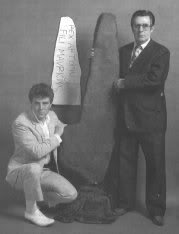
The stone and the authors c. 1988(?)Source: Book cover photo/Treasure one hunting)
 The stone on a blanket (Source: The Holy Kingdom)
According to the Britannia website:
The excellent "Bad Archaeology" website deals with this stone (and the cross):
The actual place where this cross was found is not described in the interim report in the Holy Kingdom book.
The form of the cross is "curious" for something supposed to be sixth century. I happen to know a little about Dark Age goldwork (actually once gave a lecture in Cambridge University on the subject many many years ago) and there really is nothing like it - but in a bad way. The form is unlike anything one would expect, its more like a 1920s/1940s celtic cross war-memorial in miniature. The authors do not indicate what they think the function of the object was, a grave marker, casket mount, processional cross, liturgical equipment. It is difficult to see how this object could have been used. It is chunky, as though the founder thought if he tried something finer it would not be a success - in other words maybe made by somebody who did not have a lot of practice. It's made of electrum, which is hugely odd for sixth century metalwork in the British Isles where there was obviously a fair amount of pure gold available for royalty at least from melting down Byzantine solidi which were being shunted up to Northern Europe by various mechanisms (Procopius in his Anekdota spitefully tells us Justinian was even paying the Brits a tribute for something or other, but do we trust Procopius?). So why low grade gold when THE Arthur with a Kumrhic kingdom covering half the island, according to Wilson and Blackett (so drawing tribute from a huge area) could have had the real thing? Finally just look at it, lumpy, unfinished (its called fettling) as cast, straight out of something like a casting sand mould and not the lost-wax moulds used by jewellers in the sixth century. Compare this with the average hanging bowl mount and consider if this really is a product of a royal workshop in sixth century Britain? The shape is wrong, the material is wrong, the inscription is pathetically wrong. How difficult would it be to 'plant' something like that in an excavation when the latter is carried out in rain and gales? How difficult would it be down in industrial south Wales for somebody who wanted to 'plant' something on Mr Wilson's and Mr Blackett's site to find somebody who with a fairly primitive workshop conditions who could knock off something like this and get the Latin wrong?
 The site has never been excavated, and its date is unknown, neither is there any evidence that it contains burials. Wilson, Blackett and Hassell interpret this as the circle within which were buried those slain at the Night of Long Knives. In the literature however the place was later sanctified by the construction of a circle of stones (brought from Ireland as war loot) which Geoffrey identifies as Stonehenge (of course the opposite is true, he knew of Stonehenge and this is the story thought up to account for it). There really is no evidence, except for the name, to link this particular monument with the Matter of Britain. In order to do so, the name would have to be shown to have an ancient pedigree, and not an antiquarian interpretation (like so many "Swedish forts" in Poland which popular folklore associated with the seventeenth century deluge, when in fact they were prehistoric and early Medieval). Wilson, Blackett and Hassell see a "conspiracy" behind the removal of the name from 1980s OS maps, but the actual explanation is that when OS started producing the landranger series, many names were verified and it was found that names that nineteenth century surveyors had given some features had little basis in local toponymy and they were removed, as were a large number of archaeological sites such as earthworks of "celtic fields" and the suchlike. This phenomenon is country-wide and nothing to do with any Anti-Arthurian conspiracy of the English establishment. In any case the evidence survives on many archived old maps. That is precisely what archives are for...
As for the humps and hollows these gentlemen point out as "graves" in this general area, take a look at Google Earth, they can be seen to extend over a large part of the hilltop and are obviously a geomorphological feature rather than archaeological ones.
Blackett & Wilson undertook a private excavation near the altar of St. Peter's Church. Here they claim to have discovered a large sword-shaped memorial which reads, in very faint 6th century style, "Rex Artorius fili Mauricius" (picture below - text outlined). Beneath this was a grave which they hurriedly sealed for future investigation. [...] As the initial discovery of the memorial stone at St.Peter's Church there had no official supervision, this major find has thus come in for considerable criticism. It is true that Early Medieval Latin is so corrupt that it is difficult to claim any particular inscription to be incorrect, but still something like "Artorius Rex filius Mauricii" would read much better, and surely the letters are much too regular for a 6th century context.
The excellent "Bad Archaeology" website deals with this stone (and the cross):
At an unknown date between 1983 and 1990, they claim to have unearthed the tombstone of Arthur, which reads REX ARTORIVS FILI MAVRICIVS. [...mentions cross - see below ...] Wilson and Blackett translate the stone as ‘Arthur son of Mauricius’, which to them confirms the identity of Athrwys ap Meurig with the “King Arthur’ of the inscription. The problem is that the inscription should actually be translated ‘King Arthur Mauricius, of the son’. [...].
The Electrum Cross
This was found in the excavations carried out - by all accounts - in appalling weather conditions. Again the "Bad Archaeology" website just about sums it up: A subsequent excavation in the church, carried out in 1990 under the supervision of Eric Talbot, at that time with the University of Glasgow, revealed earlier structures and a silver cross, again with an inscription (PRO ANIMA ARTORIVS), was found. If genuine, these inscriptions [memorial stone and cross] would be good evidence for the existence of someone whose name could be written as Artorius in Latin in early medieval Wales. However, neither inscription has been submitted for analysis by acknowledged experts in the field and even to an outsider, they appear curious. For a start, both are ungrammatical, if they are meant to mean what they are claimed to mean. Wilson and Blackett [...] would like to see the cross inscription as being ‘For the soul of Arthur’, it is actually ‘Arthur for the soul’ (which is probably not as effective as chicken soup). In other words, these inscriptions are, at best, crude forgeries by someone with a very poor knowledge of Latin and certainly poorer than we would expect in early medieval Wales.Indeed contemporary with the Llandaff charters (in Latin) which are used to support the authors' identification and the excellent if turgid Latin of Gildas. Surely a ruler as important as THE King Arthur would have had at least one scribe, clergyman or scholar in his court able to get a three word inscription for his grave memorial right.

The actual place where this cross was found is not described in the interim report in the Holy Kingdom book.
The form of the cross is "curious" for something supposed to be sixth century. I happen to know a little about Dark Age goldwork (actually once gave a lecture in Cambridge University on the subject many many years ago) and there really is nothing like it - but in a bad way. The form is unlike anything one would expect, its more like a 1920s/1940s celtic cross war-memorial in miniature. The authors do not indicate what they think the function of the object was, a grave marker, casket mount, processional cross, liturgical equipment. It is difficult to see how this object could have been used. It is chunky, as though the founder thought if he tried something finer it would not be a success - in other words maybe made by somebody who did not have a lot of practice. It's made of electrum, which is hugely odd for sixth century metalwork in the British Isles where there was obviously a fair amount of pure gold available for royalty at least from melting down Byzantine solidi which were being shunted up to Northern Europe by various mechanisms (Procopius in his Anekdota spitefully tells us Justinian was even paying the Brits a tribute for something or other, but do we trust Procopius?). So why low grade gold when THE Arthur with a Kumrhic kingdom covering half the island, according to Wilson and Blackett (so drawing tribute from a huge area) could have had the real thing? Finally just look at it, lumpy, unfinished (its called fettling) as cast, straight out of something like a casting sand mould and not the lost-wax moulds used by jewellers in the sixth century. Compare this with the average hanging bowl mount and consider if this really is a product of a royal workshop in sixth century Britain? The shape is wrong, the material is wrong, the inscription is pathetically wrong. How difficult would it be to 'plant' something like that in an excavation when the latter is carried out in rain and gales? How difficult would it be down in industrial south Wales for somebody who wanted to 'plant' something on Mr Wilson's and Mr Blackett's site to find somebody who with a fairly primitive workshop conditions who could knock off something like this and get the Latin wrong?
"Mynwent y Milwyr "
There is a large roughly circular earthwork on the west end of the ridge. On older maps it is apparently labelled Mynwent y Milwyr but other names include Coedcae Gaer and apparently on some old maps as "Caer Caradog". The site has never been excavated, and its date is unknown, neither is there any evidence that it contains burials. Wilson, Blackett and Hassell interpret this as the circle within which were buried those slain at the Night of Long Knives. In the literature however the place was later sanctified by the construction of a circle of stones (brought from Ireland as war loot) which Geoffrey identifies as Stonehenge (of course the opposite is true, he knew of Stonehenge and this is the story thought up to account for it). There really is no evidence, except for the name, to link this particular monument with the Matter of Britain. In order to do so, the name would have to be shown to have an ancient pedigree, and not an antiquarian interpretation (like so many "Swedish forts" in Poland which popular folklore associated with the seventeenth century deluge, when in fact they were prehistoric and early Medieval). Wilson, Blackett and Hassell see a "conspiracy" behind the removal of the name from 1980s OS maps, but the actual explanation is that when OS started producing the landranger series, many names were verified and it was found that names that nineteenth century surveyors had given some features had little basis in local toponymy and they were removed, as were a large number of archaeological sites such as earthworks of "celtic fields" and the suchlike. This phenomenon is country-wide and nothing to do with any Anti-Arthurian conspiracy of the English establishment. In any case the evidence survives on many archived old maps. That is precisely what archives are for...
As for the humps and hollows these gentlemen point out as "graves" in this general area, take a look at Google Earth, they can be seen to extend over a large part of the hilltop and are obviously a geomorphological feature rather than archaeological ones.