.
In an insulting You Tube video amateur treasure seekers Wilson, Blackett and Hassell claim I am part of some vast English conspiracy to cover up the "truth" about King Arthur, and that I misrepresent the sources of their information. Given the manner in which this was presented I feel motivated to discuss their "findings" in more detail than had been my original intention. I do not intend to devote too much time to this, so instead of going to the libraries (I'd have to visit several in Warsaw) to compile a deeper response, I feel it is enough and more time-efficient for me to use the same Internet resources that these gentlemen direct their readers. They say that the "Wikipedia" pages and other resources on the internet all "lie about Arthur" (part of the same "conspiracy" you see?) so please if you want to be sure of the information, check these sources in real books too. But lets start with the internet and see how far we get.
Here is a typical video produced by the Wilson, Blackett and Hassell team presenting their views that
Mynydd y Gaer was the centre of the kingdom of THE King Arthur of the legends and his burial place.
Artorius Rex & the Ancient Monuments
http://www.youtube.com/watch?v=aGFyFd9jKEA the first ancient TV show is interesting (what document describes the hills?) but the second segment (from 1:18) is a significant bit.
The other Arthurs
There were many (about a dozen) rulers in the Dark Age kingdoms of the British Isles that have names sounding like “Arthur”. They are listed and championed in a variety of books, articles, and internet sites. In a search for "the historical one”, obviously what is being sought is one living at the right time to be associated with at least some of the events associated with Arthur. Like for example the
battle of Badon (that Arthur was the commander here is accepted by Wilson and Blackett, so for the purposes of this essay let's accept it was so). The date of Badon however is famously unclear, most people accepting it was in the decades at the turn of the fifth and sixth centuries (perhaps in the 490s). Badon cannot be later than the lifetime of Gildas, more specifically the completion of his De
Excidio et Conquestu Britanniae. So any “historical Arthur” would have been at battle-winning age around about this time.
The genealogies of the ruling houses of the sub-Roman and post-Roman kingdoms of the Celtic west are extremely amorphous (those of the Anglo-Saxon ruling houses are not much better) and often exist in several versions. Their chronology - and sometimes even sequence - is also unclear. Wilson and Blackett take the chronological uncertainties of one of these to extremes to make their "Arthur" fit (though the way they manage this is not closely argued as far as I can see). It is with this aspect of their work that many scholars who specialise in the area take issue.
Here's the
map from Wikipedia to help get some orientation about what areas we are dealing with. The Saxons are way off to the right in the period (very beginning of the sixth century) we are discussing:

Wilson and Blackett focus on the kingdom of Glywysing (more or less modern Glamorgan) between the Afon Llwyd (which has Caerleon at its mouth) and the River Towy. They also refer to Ergyng (later referred to by the English as Archenfield). Let's start with that. The most likely sequence and approximate chronology of the rulers of Ergyng (Ercing) can be reconstructed as in, for example, to take the first version to hand - the Celtic Kingdoms of the British Isles (though other versions are possible, my choice here is not because I think the webpage inherently more reliable than any other source, it's just to give an overview of why Wilson, Blackett and Hassell's identification is problematic). The most important point here is that the chronology based on various sources including Welsh genealogies places the marriage of Onbrawst (the mother of Athrwys ap Meurig) in the 630s, in other words 140 years after the conventional date of Badon, making it just a tiny bit difficult for Athrwys to be commanding the troops at that battle.
The non-Wilson and Blackett chronology of the kingdom of Glywyssing is also given in the Celtic Kingdoms of the British Isles in two places, here and here. The sequence of kings that interests us here:
? - c.625 St Tewdrig ap Llywarch ("Theoderic"),
c.625 - c.665 Meurig ap Tewdrig King of Gwent, Glywyssing, & Ergyng.
[by marrying the Onbrawst, the daughter of King Gwrgan Fawr (the Great) of Ergyng, Meurig effects a union of the two kingdoms]
c.680 - c.685 Athrwys ap Meurig [This is the man Wilson and Blackett see as THE historical Arthur behind the legends].
c.715 Morgan ap Athrwys
c.735 Ithel ap Morgan
Now of course the problem with all this is that in order to make Athrwys ap Meurig the Badon-fighting Arthur, you would have EITHER to shift the date of Badon forwards (rather impossible since Gildas really cannot be brought forward with it and he mentions it as having been fought in the year of his birth) OR you'd have to find a reason to shift the date of this whole dynastic sequence back 190 years. This though would create problems in that St Tewdrig ap Llywarch is recorded in the histories as having died fighting the Saxons, but there is no evidence for Saxons this far west in the 430s (which is when he would have been active if we shift the whole lot backwards in order to make Athrwys contemporary with Badon). You'd also end up with a bunching up of rulers in the immediate post-Roman period and an embarrassing gap at the other end of the chronology. If the only reason to shift them is because "Athrwys" sounds a bit like "Arthur" (it should be noted that the identification has been challenged on linguistic grounds by most of those who specialise in such things who have examined the issue), then that is not really sufficient reason for such jiggery-pokery with the most likely sequencing of the - admittedly scant and difficult - records which place Athrwys almost two centuries later than the Arthur of Badon.
One Uther Pendragon?
In order to make the claims they do, Wilson and Blackett claim that the legendary Arthur is based on two different kings called Arthur, one fourth century one, the other (Arthur II) living latr who is the subject of this text. They also feel that "Uther Pendragon" is not a name, but a title (like the Saxon "Bretwalda"). Hence in the video we hear Wilson dismissing the "other pendragons" whose burial places are known only to conclude that the "only pendragon" who can have been buried at Llanharen "must have been Arthur". This is a huge leap of logic. The term Uther Pendragon is known only from the literature where it always appears as a personal name of a character well known. There seems to be very little support from the sources, either early or late to treat this as a title. Indeed such a usage would make a nonsense of the hero-tales where the name appears alongside other personal names. As far as I can see a case has not been made by Wilson and Blackett for treating three generations of the ruling house of titchy little
Glywysing as each bearing this title one after the other (never happened with the bretwaldaship). As we shall see in the literature Wilson and Blackett use to "prove" their case, there is only one Uther Pendragon mentioned and that is the father of Arthur, and in some of the texts they use he is said to have been buried at a place the documents call "Caer Caradoc".
The site at Llanharen.
The identification of the hill (Mynydd y Gaer) above Llanharen as the site of Arthur’s burial is a misunderstanding. In the video we looked at above Wilson can be seen expounding his theory. He says that in some early documents somebody called Uther Pendragon is buried at Caer Caradoc, and he has set out to find out where that was (allegedly “nobody appears to have bothered to find that out” before him. That is not exactly true).
I want to start with the second alleged body of evidence he mentions first and get that out of the way. He says that the information that somebody called Uther Pendragon is buried at "Caer Caradoc" is mentioned in "sixth century Welsh poems", but does not cite them. Well, there are not many sixth century Welsh poems, but Uther is mentioned in other "early" examples. One of them is the "Marwnat Vthyr Pen" The Death-song/Elegy of Uther Pendragon from the Book of Taliesin does not mention a burial place (and is not 6th century). He is mentioned in the 10th century Arthurian poem Pa gur yv y porthaur ("What man is the gatekeeper?"), but again without any reference to his burial place. Uther is also mentioned in the Welsh triads but in none of them is mentioned he burial place. Unless I have missed something obscure the claim that the burial place of Uther Pendradgon is given as "Caer Caradoc" in these early Welsh sources appears to be misinformation.
The first group of texts that Wilson cites as evidence that Uther Pendragon was buried at a place called "Caer Caradoc" are a series of texts called the Brut (the Brut of England). The problem is that he does not mention that the texts he refers to as the Bruts of England are a translation into Middle English (by a bloke called Layamon) of the Roman de Brut poems (c. 1155) of Wace. According to Wilson, this burial place is “confirmed” (ie repeated by somebody he calls “Matthew of Westminister” – see here,he means the Flores Historiarum (Flowers of History) written some time after 1188 in far-off St Albans and Westminister, which as one of its authors noted selected "from the books of catholic writers worthy of credit, just as flowers of various colours are gathered from various fields". Wilson also says it is also confirmed (repeated) in the Brut y Tywysogion compiled after 1164 at Strata Florida Abbey AND [the name he gives is significant] – “Gruffudd ap Arthur,” That of course is none other than Geoffrey of Monmouth, the author he says they do not place any reliance on. Just a little sleight of hand there I feel...
So, in fact all of these "sources" are taking their material from Geoffrey of Monmouth (which is what I said when Wilson, Blackett and Hassell accuse me of "lying"). we remember that this the source the authors say everybody should be "wary" of, but in fact the SOLE "evidence" on which they base their case is in fact Geoffrey. Sneakily referring to an author called Gruffudd Ap Arthur who allegedly "confirms" what the others say is extraordinarily wobbly logic. Wace translated Geoffrey from Latin to French, and Layamon translated it into English, and the Flores Historiarum and the Brut y Tywysogion are rehashing the same Galfridian material.
So, basically, the question hangs on how reliable a historian Geoffrey of Monmouth was, and where he got the information (inspiration) for what he was writing. For most of us, it is clear he was making up vast chunks of his story, or extrapolating them from some single disconnected facts. On the one hand Wilson and blackett seem to pay lip service to this idea ("be wary of Geoffrey of Monmouth") but on the other hand appear to treat whole chunks of his narrative as a true reflection of events...
That actually is irrelevant to what I am discussing here. We need to consider what Geoffrey of Monmouth tells us about the burial place of Uther Pendragon.
A whole section of Geoffrey's narrative centres around a specific region. The monastery of Ambrius appears in book VI, 15 the Night of the Long Knives (when Hengest killed all the British nobles by treachery), and the bodies of the slain were buried nearby at “Kaercaradene” "now Salisbury at a burial place near the monastery of Ambrius, the abbot, who was founder of it”. In Book VIII, chapter 9-12 describes the removal of the stones of the “Giant’s dance” to the “Mound of Abrius” erected by Merlin over the burial place of the nobles slain in the Night of Long Knives massacre at the “convent which maintained 300 friars”. Then we come (Book VIII, ch. 24) to the burial of Uther (here the father of Arthur) who died in Verulam (St Albans) and was buried with “regal solemnity” in the ”convent of Ambrius” close by the tomb of Ambrosius Aurelianus “within the Giant’s dance”, while mortally wounded Arthur (Book XI, chapeter 2) goes to Avallon “to be cured of his wounds” and is not mentioned again. His successor Constantine however is buried alongside Uther “within the structure of stones which was set up with wonderful art not far from Salisbury and called in the English tongue Stanhenge” (Book XI, 4).
This is pretty unequivocal. Geoffrey is quite clear where all these ancient kings were buried, and identified this place with important features in the landscape. Writing of Salisbury, Geoffrey had in mind the earthwork known as Old Sarum, with its cathedral (here and here). New Sarum was founded after Geoffrey's time c. 1216)
The massive circular earthworks surrounding the hilltop are of prehistoric origin, and contained a densely built up town and cathedral. It is unclear whether calling it Caer Caradoc was a tradition in the 1130s (one which seems not to have left a trace), or Geoffrey;s conceit (Caradoc was a duke of Cornwall roughly contemporary with Arthur in Geoffrey's narrative). Again, the name of "Ambrius" is not known in any other sources and it seems Geoffrey made it up from the name of the town of Amesbury five kilometres to the NNE of Old Sarum. Stonehenge is 11 km to the north of Old Sarum. It seems that in Geoffrey's mind these places were all in the same general area, Caer Caradoc (the walled area of Sarum), the monastery of Ambrius (Amesbury?) and the Giant's Dance (Stonehenge). There is no clear evidence he was ever in the area and it was here he set some of the important events of these times. What is significant is that Geoffrey may have still been been intent on flattering the Alexander of Salisbury, bishop of Lincoln (for it was for him that he had translated the Prophecies of Merlin).
Nevertheless the point is it seems pretty clear that all these elements were an artificially constructed narrative around the existence, obviously known to Geoffrey of the Giant's dance (Stonehenge) and adjacent features to which had accreted various stories - whether in folk or scholarly tradition we cannot say, and Geoffrey had woven them into a whole adding material of his own inspiration.
What is equally clear is that one cannot take isolated elements OUT of that literary construction and simply apply them to another location, just because it has the same name as the place mentioned. There are several hills called "Caer Caradoc" in the west of Britain. There is no tradition of an Ambrius at Llanharen, no evidence of a monastic house of 300 friars, no stone circle on a postulated burial site (let alone one which is called Giant's Dance and was brought from the West). Neither is this a place one can imagine being set as a meeting place at the end of the fifth century between "Hengest" and "Vortigern" and his 300 or so nobles (Saxon territory finished far to the west at the time of the Night of the Long Knives, whenever this no doubt wholly imagined event would have taken place).
A final point, if this Arthur was the all-powerful monarch of half the British Isles, why is the church he built in the alleged "centre" of his kingdom, and in which stands his pathetically inadequate memorial stone, so pathetically small that it was replaced by the equally small Norman church. Why did this "Arthur" not found a royal monastic house here? Where are the archaeological traces on Mynnydd y Gaer of the splendours of (any) Arthur's court?
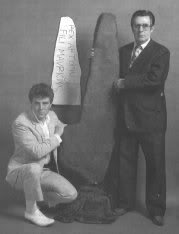
Whether or not this church is the burial site of a local king Athrwys ap Meurig is dubious - the memorial stone said to have been found here seems not to be authentic. No traces found in the excavation seemed to suggest a seventh century royal burial (his grandfather had it seems from antiquarian accounts been buried in a stone coffin, so why not Athrwys?). Certainly there seems little real reason to see St Peter's Chuch above Llanharen as the burial site of "an" Uther pendragon, still less link that with the burial of the King Arthur of the later legends.
 In what way I am "lying" (or clowning) is not explained. I presume its because I do not believe their interpretations I am labelled a liar. It is, however, entirely true, I truly do not believe their interpretations and I will attempt to set out just SOME of the reasons why below.
 "Ignorant" liar now... Certainly I do not set out to "mislead" about what I think of these gentlemen's "research". Of course the whole idea of scholarly discourse is not name-calling, but discussion of facts and their interpretation.
 Well, who is now being deceitful? First of all I did not and do not claim they use "only this source". What I said can be seen in my original post by anyone able to read and understand English. Secondly we will see (below) that in their presentation of the evidence, these gentlemen manage to slip in Geoffrey under another name...
 "Constantly" is a word which means more than once. Until this appeared I wrote one post about Wilson, Blackett and Hassell's "researches" - so it's hard to see the justification for the first comment.
  As for the second... the only one of their half a dozen books to be commercially published (Holy Kingdom - the rest are what we call vanity publications) has been translated into Polish and I not only have a copy (I keep it with my Von Danikens when its not being used to level up a wobbly table leg) but have read it and scribbled all over it. In addition, the maps look like they've been drawn with sharpened sticks. It is a dreadful book.
 "Gain points" with whom? Wilson, Blackett and Hassell apparently flatter themselves that mainstream academia is a bit interested in their theories. I imagine most scholars would feel that they belong on the shelf with the Von Danikens and the crystal healing (which geologists and minerologists do not take much interest in either). I am not particularly known for my ability to "toe any line".